 info@asev.org
 530-753-3142



2025 ASEV Best Papers Awards Announced, Available for Free
- April 14, 2025
- Category: eNews
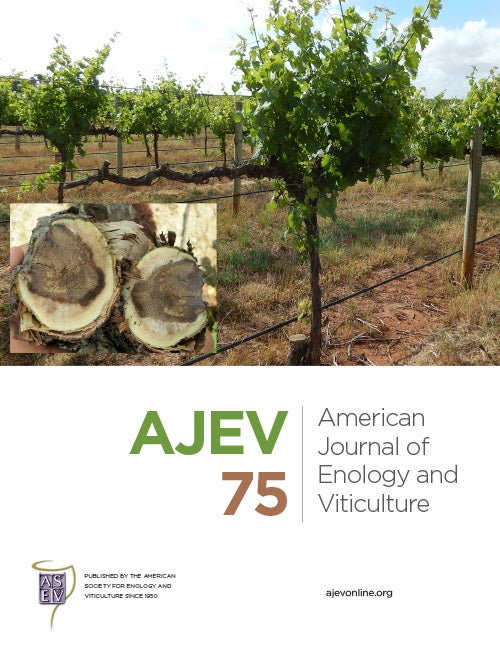
Congratulations to the 2025 ASEV Best Papers Award winners! The selected papers will be presented at the ASEV National Conference in June in Monterey, California. You can read both papers for free on the AJEV website.
This year’s winning papers include:
For viticulture: “Trunk Cambium Facilitates Pre-Symptomatic and Year-Round Detection of Grapevine Red Blotch Virus Using the LAMP Assay,” written by Jennifer K. Rohrs, Hannah G. Fendell-Hummel, Sarah L. MacDonald, Malcolm B. Hobbs and Monica L. Cooper from the University of California Cooperative Extension, Napa County. This study found that testing grapevines for red blotch virus using a sample taken from the grapevine’s trunk (the cambium layer that separates the bark from the wood, specifically) is more effective than using leaf samples. The new method, which uses the loop-mediated isothermal amplification (LAMP) assay, can detect the virus before the appearance of symptoms. Unlike traditional leaf petiole testing, which only works during certain parts of the growing season, trunk cambium sampling can be used all year. In Napa Valley vineyards, trunk cambium sampling detected infections at a rate twice that of cane tissue sampling, and over 12 times that of petiole tissue sampling. Many vineyard managers have already begun using this technique, along with visual inspections, to detect the virus early and prevent its spread.
For enology: “Prevalence of Wildfire Smoke Exposure Markers in Oaked Commercial Wine,” by Mango Parker, WenWen Jiang, Adrian D. Coulter, Tracey E. Siebert, Eleanor Bilogrevic, I. Leigh Francis, and Markus J. Herderich from Australian Wine Research Institute. This study examined how to determine if a wine’s smoky flavor originates from standard aging in oak barrels or from exposure to wildfire smoke. Several types of Australian wines that had not been exposed to wildfire smoke were tested to establish baseline levels of smoke-related chemicals. The authors found that oak barrels naturally introduce certain smoky compounds, like guaiacol and syringol, at relatively high levels, and while markers that typically indicate wildfire exposure were present, they only occurred in small amounts. This research presents a clearer picture of the phenolic compounds typically found in oak-aged wines, enabling researchers to confidently identify which of these wines have been affected by smoke.
Share:


Latest News
ENEWS
January 2026 Technical Liaison Committee Minutes
The meeting minutes from the Technical Liaison Committee (TLC) meeting on January 28, 2026, are now available to view for ASEV members. Members will need...
PRESS RELEASE
Leading Fermentation Scientist David E. Block Earns ASEV’S Highest Honor
UC Davis researcher honored for advancing modern fermentationscience and winery practice Davis, Calif., February 26, 2026 – Dr. David E. Block of the University of...
ENEWS
Sponsorship & Advertising Opportunities at the 2026 National Conference
Don’t Just Attend. Be Seen. The 2026 ASEV National Conference will be a joint conference with the ASEV Eastern Section Annual Conference, creating a valuable...
ENEWS
Plan Ahead for the 2026 ASEV National Conference in Boise
The 2026 ASEV National Conference will be a joint conference with the ASEV Eastern Section Annual Conference, creating a valuable opportunity for industry, researchers, and...
ENEWS
ASEV Scholarship Applications Due March 1
ASEV is accepting scholarship applications and submissions are due March 1. ASEV scholarships support students pursuing degrees in viticulture, enology, and related fields that strengthen...